Monday, 29 September 2014

The Golden Age of Illustration


Illustrations have been used for centuries dating back to the Ancient Civilizations: the Ancient Egyptians decorated their tomb walls however this was not called illustration but called 'art work'.

 The late 19th Century became known as The Golden Age of Illustration  because as technology developed prints were easier to mass produce and more people started reading which meant that more books were being produced.


Charles Dickens 


Illustration became wide spread as artists were getting commissioned to add illustrations to books for authors such as Charles Dickens. This meant that illustration became established as a trade and more artists started to illustrate.


Charles Dickens worked closely with his illustrators, his works came out in installments and the illustrators began work before the next installment was due so they could be printed together. Dickens gave his illustrators a general summary of the chapter that he was writing so that the illustration was relevant and gave the readers a clear view of what was being narrated. Often the illustration appeared cut into the text so that the reader could see the story as they read it.


scene from "Oliver Twist" by George Cruikshank
characters from "Great Expectations"


Kelmscott Press


The Kelmscott Press was a collection of works by William Morris and some colleagues, the books featured their works. Morris was a writer and a poet who wanted his works to look good. He had worked on producing a book however he decided to create his own press company.

William Morris took influence from the Medieval and the Pre-Raphaelites and highly decorated the pages in the books. The books were designed to be read slowly and the illustrations and typography appreciated as much as the content of the words.

He created three new typefaces: Golden, Troy and Chaucer.

Edward Burne-Jones ~ The Wood Beyond The World by William Morris ~ Kelmscott Press ~ 1894
Click the image to turn the pages and read the full text. The second turning takes you to the frontispiece and the first page of the story including this compelling illustration by Edward Burne-Jones.
The frontispiece to "The Wood Beyond the World"
Illustration by Edward Burne-Jones
Page from Kelmscott Chaucer
decoration by William Morris
illustration by Edward Burne-Jones

w
w

Aesthetic Movement


This movement aimed to show that beauty was possible in everything, the artists in this movement sparked an interest in interior design and people realized they could have beauty in their everyday lives.

wallpaper by Walter Crane
Middle Class citizens began to decorate their homes fascinated by "The House Beautiful" artists such as Walter Crane were commissioned to design works that furniture and designers could use to sell their products.


Many artists took influence from other countries such as Greece, Japan and throughout Europe, it is suggested that in the wallpaper shown above Crane has taken influence from the Greek and Japanese by using similar techniques of solid blocks of colour and black outlines.
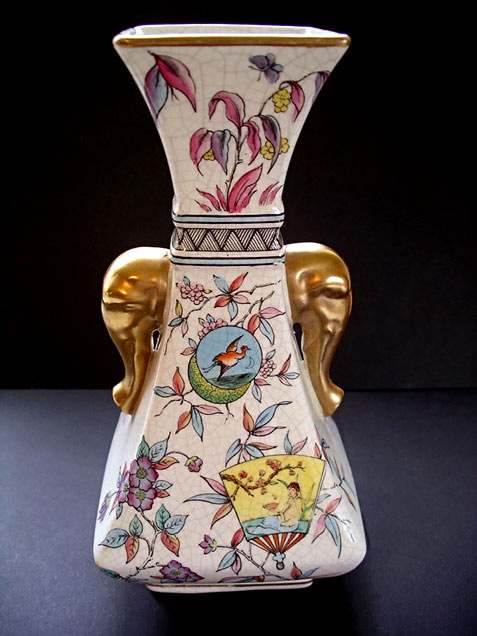
CHRISTOPHER DRESSER OLD HALL JAPANESE AESTHETIC STYLE ELEPHANT HEADS POTTERY VASE
pottery vase by Christopher Dresser
Christopher Dresser was the first European artist who went to Japan after the reopening of the border, some of his works show how the different culture has inspired his works. He created works for the interior of homes. He created a full set of tableware that was easily available for all homes as well as textile works, vases, furniture and glassworks.
Queen Anne Revival
Kate Greenway
Beatrix Potter
women accepted into art world - kids books


Useful Links

http://www.metmuseum.org/toah/hd/praf/hd_praf.htm

http://www.artsandcraftsmuseum.org.uk/Arts_and_Crafts_Movement/Emery_Walker_Library/The_Private_Press_Movement/Kelmscott_Press.aspx

http://charlesdickenspage.com/illustrations.html

http://www.artcyclopedia.com/history/golden-age.html

http://artofnarrative.tumblr.com/post/77570089830/edward-burne-jones-the-wood-beyond-the-world-by

http://www.victorianweb.org/authors/morris/kelmscott.html

http://www.flashcardmachine.com/print/?limit_flagged=include&topic_id=612879&mode=single&cpp=6&size=5x8

http://www.vam.ac.uk/content/articles/a/aestheticism/

http://www.veniceclayartists.com/design-innovator-christopher-dresser/

http://www.bricksandbrass.co.uk/design_history/queen_anne_style.php

http://www.carnegiegreenaway.org.uk/greenaway/

http://www.historytoday.com/richard-cavendish/death-kate-greenaway

http://www.peterrabbit.com/en/beatrix_potter/beatrixs_life/beatrix_potters_art/landscapes

Monday, 22 September 2014

Picturing the City

Brassai

Edgar Degas "Absinthe Drinker" 1880's

Brassai "Cafe Scene" 1930's


Brassaï once summed up his photography by saying:
 "Basically, my work has been one long reportage on human life." (Here)

Brassai photographed real life people as he wanted to raise awareness of the problems that people were going through. His photograph Cafe Scene takes influence from the painting by Edgar Degas who shows a French woman in a bar drinking Absinthe, 

Brassai was one of the first photographers to photograph at night and because of this he helped to shape photography by showing a new side of the city that was not present in other photographers works, people such as hooligans and prostitutes. At the time he was photographing exposures were slow as photography was still relatively new so he used a flash gun to illuminate his scenes and estimated his exposures by trial and error.


Jacob Riis


Jacob Riis "Bandits Roost" 1890
Jacob Riis "5 Cents a Spot" 1890


He shows how the lower classes in New York lived in poverty. Riis was a social activist and he wanted to bring light to the conditions that many people lived in, in many cases the poor were blamed for the conditions that they lived in however Riis thought that it was not their fault and they had no choice.

In the photograph "5 Cents a Spot" the men have all paid 5 cents just to be able to sleep on the floor in the crowded house. He has captured them in a candid moment as he used a new piece of technology which was being developed: the flash gun. 

http://www.tenement.org/blog/todays-other-half/
http://www.moma.org/learn/moma_learning/jacob-august-riis-lodgers-in-bayard-street-tenement-five-cents-a-spot-1889


Thomas Annan


Thomas Annan "Glasgow Close" 1867


Thomas Annan photographed around Glasgow to show the slums before the council refurbished the areas. His work generally focused on details of the Wynds and the Tenements, his work did not focus on the people who lived in these conditions but more on showing the details in the area such as washing lines and the gutters.


http://www.ngaiopress.com/highslum.htm
http://special.lib.gla.ac.uk/exhibns/month/Mar2006.html


Charles Sheeler

Criss–Crossed Conveyors, River Rouge Plant, Ford Motor Company


He photographed within the Ford plant for six weeks between 1927/28, his works focused on the impressive machinery and the American ideals of power and revolution. The project shows how times are changing in technology as humans working on a farm has evolved into machines running themselves in factories.
These works influenced some of his later works that he created with different media.

http://www.metmuseum.org/toah/works-of-art/1987.1100.1

The course of urban photography is an ever changing one as attitudes are changing as times change and technology becomes more advanced. Urban photography has changed from the photographers interacting with the people they were photographing into the photographer removing the human element to create a chilling and formidable perspective on what the future could become as we as humans become dependant on machines.

Introduction to Level Five


Japanese Youth Cultures


The youth culture in Japan has a wide amount of sub-cultures which seem innocent and sweet although they have an undercurrent of a darker nature.


There are many grown adults still dressing as part of the youth culture as there as many fans of these styles.

The style of dress possibly started as an act of rebellion against the strict standards in social culture and they are seen as turning against traditional customs.

Standards in Japan are set very high and all children are expected to have the highest grades and get into top universities so that they can get the best jobs.

The youth culture is still relatively new compared to youth cultures from western societies.


Tokyofashion.com  (?)


http://www.tokyo-top-guide.com/japanese_youth_culture.html/

Monday, 17 March 2014

The Kane Chronicles


A series of novels based around Egypt Mythology.


The Red Pyramid

In this book the main characters ( Carter and Sadie Kane) accidentally unleash five gods from the gatesof the underworld they must stop them and return them before they take over the world.

Throne of Fire

In this book the children try to resurrect Ra by collecting the three scrolls while being hunted by Egyptian Gods that have also been resurrected.

The Serpents Shadow

The final book in this series is about a box that is said to contain the shadow of Tutankhamen.

Wednesday, 12 March 2014

Egypt From Alexander to the Copts


Egypt
From Alexander to the Copts
An Archaeological and Historical Guide


Edited by Roger S. Bagnall and Dominic W. Rathbone (2004)


1.3 Languages and Scripts

The earliest system created was the Hieroglyphics, later known as 'sacred incised letters' when the more popular and easier writing style 'demotic' came into use. Another form of writing was Hieratic created as a simpler easier cursive form of Hieroglyphs, it was sequences of Hieroglyphs that was designed for rolls of papyrus written with a brush of rushes, this style of writing was useful for legal documents.

Hieroglyphs could both represent the picture and have a sound, a determinative stroke to mark whether the symbol represents the picture or not

This system was used up till AD 394, this is the latest date on the inscriptions.

The Rosetta Stone was the turning point in understanding the Hieroglyphs as one piece of text was written in Hieroglyphs, Demotic Egyptian and Greek.

1.4 Religion


" Because of the profusion of surviving funerary monuments and materials, it is easy to forget that this was also a religion for the living "

The Ancient Egyptians believed that the soul could continue to live as long as the soul had a body, mummification was practiced by also Greeks and Romans. Sacred animals were also mummified as the cemetery's of Sacred cats, crocodiles and the Catacombs of the Apis bulls shows.
The Egptians did not only have temples and monuments, they also had many other objects that they believed helped them.

" Egyptians temples were centres of life, not just static buildings "

1.5 Literature

The Demotic Chronicle is one of the Demotic Pieces of Literature found, it reads as a prophecy - stories about magic featuring the high priests of Memphis and...

" narrative text featuring the popular King Amasis of the Saite Period; and the Myth of the Eye (daughter) of the Sun, in fact a narrative framework for a series of animal fables "

other religious texts include the the ritual for embalming the Apis bull at Memphis.

In the late 19th century many demotic texts were discovered that could have been from the private libaries of the priests of Fayyum village of Soknopaiou. Texts include religious pieces of gods and wisdoms and technical works such as medicine, mathematics, law and astronomy. An illustrated piece also documents plants, detailing what should and shouldn't be used in medicine.

1.6 Art

Some distinct portraits from Graeco-Roman Egypt include the mummy portraits, which are representing the deceased. The later portraits can be dated by the details in the hair, clothes and jewelry.

The best surviving mummy portrait is the Stucco Mummy of Artemidoros

Artemidoros


" Museum collections contain an amazing variety of other artifacts: inscribed temple and funerary reliefs; pottery; coins; glassware; statuettes of gods, worshipers and animals carved in wood or made from terracotta, faience (glazed quartz frit), or bronze; jewelry, especially gold rings, earrings, bracelets and necklaces " 
There are also many objects that give an impression into daily life such as :

" glass, childrens toys; bronze mirrors; models of houses; boats, temples and altars; agricultural implements (winnowing shovels, sickles, pitchforks); doors and doorlocks; tables and reading stands; toiletries (combc, hair pins, kohl sticks); baskets; spindles, whorls, crochet hooks, sewing needles; boxed pairs of dice; writing materials and products (pens, inkpots, papryi, ostraka, tablets) "

Alexandria was famous for glassware, the art was introduced into Egypt from Phoenicia.
The technique of pouring hot glass around moulds produced many works such as perfume vials, flasks, pitchers, plates and mosaic tiles.

The Great Mysteries of Archaeology


The Great Mysteries of Archaeology
The Pyramids

M.R. Luberto
A David and Charles Book (2007)


The Birth of Egyptology
(page 18-24)

July 1978, scholars arrived in Alexandria to study the Egyptian culture, particularly the Ancient Egyptian civilisation.
The commission of Arts and Sciences, led by Dominique Vivant Denon, calculated, measures and recorded everything about each monument they found. They collected samples of rock and plants.
The soldiers who escorted them did not understand why they were there and risking their life for it.

The outcome;

" Description de l'Egypt ou Recueil des observations et des recherches qui ont été faites en Egypte pendant l'expédition de l'armée français "   (page 18)
( Description of Egypt: collected observations and research carried out during the French Military expedition)  

They freed the pyramid of Khufu from the sand debris blocking the entrance, however the were called to retreat so their work was left unfinished.

In 1799 a soldier in Napoleons army discovered the Rosetta stone, which has a decree of Ptolemy V written in hieroglyphics, ancient Greek and demotic. In 1822 the hieroglyphs were translated by François Champollion.


The Prisoners Heads
(page 40 - side box)

A sculpture representing two prisoners, enemies captured by the Pharaoh.

Both subjects have their hair styled into two locks, however their faces have been sculpted very differently; the face on the right is believed to be a Libyan (portraying the western people)  with a short goatee, while on the left the man is portrayed with a full beard and moustache which cover the bottom half of his face (lips, cheek, chin) he is thought to be Asiatic (portraying the Oriental people.)

Showing people that have been defeated by the Pharaoh was a common theme, this was because it showed the Pharaoh as a great ruler and able to keep the peace and the world in order. Even in times of peace this theme was still common, I think it has been used as propaganda supporting the Pharaoh and showing what a great ruler he is and to help gain the support of the people as they will see him as a successful leader.


An Intricate Puzzle of Riddles
(page 44-47)

There are many theories about why and how the Pyramids were created.
" Gods came down to Earth to reveal secrets to the inhabitants of the Nile valley" (page 44)
" Preachers of obscure and esoteric doctrines applied strange theories or magic to these structures " (page 44)
" It was finally understood that these were monuments erected by the Ancient Egyptians to house the Pharaohs after death, monuments whose characteristics were intended to contribute to the eternal fame of the sovereign. " (page 44)
Another theory was that they were granaries.

Death was not the end for the Egyptians, it was considered the start of the journey into the afterlife. The death of a Pharaoh had meaning for the entire community because the Pharaoh was thought to be a god on Earth.
They believed that their afterlives were linked with his as their lives on Earth depended how the Pharaoh ruled.
The pyramids were built to protect the Pharaoh in his journey, so that he could avoid desecration.


Many other theories surround the construction of these pyramids:

when were they built?
how did they construct them?
why is there no evidence of machinery left?
how did they have the knowledge to make the calculations required?


Politics and Society in the Old Kingdom
(page 67-71)


society Hierachy :

Pharaoh and his family
vizier
high priests of various cults
high officials of the army

scribes
priests
soldiers
artisans
specialised workers

farmers
slaves


From the Concept of the Mastaba to the Pyramid
(page 88-91)


"  The three axes of the pyramids represented significant concepts: 
the vertical axis represented the aspiration to the divine that linked the Pharaoh to his father Ra; 
the north-south axis was the earthly axis, parallel to the Nile that was so important for the Egyptian people; 
the east-west axis, which indicated the path of the sun, represented the heavens, and its daily cycle of death and resurrection was a symbol of constant regeneration. " ( page 91)
What does the word pyramid mean?
(page 106 - side box)

Has a Greek origin, comes form 'pyramis'

" the name of a sweet made of grain, made typically in a conical form."

the Egyptians referred to te pyramids as 'mer' which translates into 'the site of ascension'

The way the monuments are coated with white limestone could be an attempt to visualise the sunlight that would carry the ruler to the heavens or down for his food offerings that were left for him.


The Funerrary Complex of Khufu and the Tomb of Hetepheres
(page 119-124)

chair from the tomb of Queen Hetepheres at Giza, c. 2580 bc

" Its thought that Khufu transferred the tomb furnishing the tomb furnishings of his mother to the tomb. "

The Solar Boat
(page 125-129)

 (insert picture from ipod)

" The Nile was the principal route for communications in Egypt. " (page 128)


The Sphinx: an Enigmatic Colossus
(page 134-137)


Khafre's desire to be better than his father (Khufu) led to the creation of the Sphinx,

This huge seated lion with stretched out front paws with a human head is representing the Pharaoh Khafre. The lions body is thought to be showing the king is with his human, divine and animal nature
he is represented.

Lions are thought to be the kings of the savannah, they are strong and fierce and will protect their pride of lions when they are in danger, I think the Pharaoh is trying to convey that he is going to protect Egypt with the same ferocity of a lion.

It is thought that the purpose of this monument was to keep guard over his pyramid and keep tomb raiders away. This is supported by a declaration that was later found :

" I protect the sanctuary of your tomb, I protect your crypt, I banish the stranger who attempts to enter, I fell your enemies with their own arm, I chase away the wicked from the funeral chapel of your tomb, I destroy your enemies in their dens so they may never come out. " (page 136)

The role of the Sphinx grew and it was later believed to go into battle with the king, it became a large military icon

In Greek mythology the Sphinx Oedipus is a female with the body of a lion and wings of a bird, she is a representation of sex which cruel characteristics.

The Dream Stele
(page 136- side box)

The role of the Sphinx was greatly increased after Thutmose IV constructed a tablet known as the Dream Stele, it was placed between the front paws of the creature and told the story that this creature had come to him in a dream and told him he would become Pharaoh if he freed it of the sand it was buried under. Thutmose worked to free the creature and built a wall that would stop the sand from surrounding it again. The Pharaoh of the time who was his brother was then killed in an attack which is still surrounded in mystery.


Art of the Old Kingdom
(page 147-149)

There was a symbolic language developed and the foundation of all creations was started.

Art was made for religious purpose, such as the pyramids, yet they did not see the works as Art but religious objects created for a purpose.

Works of art that have survived have only survived because of chance and those that have been found have all been found deep in the temples or tombs.


Paintings and Reliefs
(page 150-157)

Painters were educated in workshops where they learnt the guide lines and traditions that they were to follow.

Paintings followed a similar style to writing, it showed things both relating to afterlife or earthly life, the Pharaoh was depicted larger than the rest of the figures, the style is similar in that things are set out in strips.

The Pharaoh is shown in the main strip, other people were shown without features in secondary strips.

The bas-relief is the effect of figures emerging from the background by removing the stone around the figures. Engraved figures were sculpted by removing the figures from the stone.


Scultpure
(page 158-161)

There was still rigid guides and rules to be followed as with paintings, they believed the statues were incarnations of the subject and that using magic formula on the engraved names on the statues could be given life and power. There were rules to be followed when creating a statue of the Pharaoh, only 7 different poses could be used to portray him all of which clearly showed his divine nature. The most common pose was the King sitting or standing with his left foot forward. Within the temples the King was shown to be accepting offerings, resting on his kilt or kneeling with vases in his hands. He was also shown to be wearing his crown, his headdress and sometimes shown wearing a kilt or triangle loincloth, other symbols include his beard.


Art of the Middle Kingdom
(page 162-167)


Sculpture grew as it was created for private citizens rather than just the Pharaoh, a new style was developed called " the block statue " it evolved from the subjects sitting on top of a block to the subject being portrayed with their knees drawn up and arms crossed so the subject became the block.


Statue of Sensusret III ( Sesostris III) 1870-1831 bc
Senmut and Neferure, block statue from Karnak
c. 1470 bc


A new type of column capital was developed, decorated on both sides with the head of the goddess Hathor. This has been intimated quite often.

Egypt Art


Egypt Art

by Rose-Marie and Rainer Hagen

The imagery of the pharaohs' kingdom

The pyramids were built to protect the kings bodies and their treasures, essentially large safes protecting from robbers who would distrupt the mummified body.

Initially only the kings and their family were mummified however this was soon widespread throughout society. The mummification procedure took 70 days, removing organs, washing and drying the body. Throughout the procedure magical spells were also used. Kings received gold masks such as Tutankhamun's. Masks of stuccoed, gilded canvas were made for private individuals. Statues were placed in the burial chamber incase the body was damaged or destroyed, the statues meant that the body could return into and the soul would not be destroyed.


The weighing of the heart ceremony was very important to the Ancient Egyptians, if their heart was weighed and heavier their heart was devoured by Ammit, in order to stop this happening they had a guide to lead them through the ceremony, this guide knew all of the answers. The answers did not have to be the truth and from later periods of time we have learnt that these correct answers were

" I have not done any injustice to another human being, nor mistreated an animal ... I have not held back the flood waters " (page 7/8)

Statues that had Gods settled in them was decorated and supplied with food, on special festivals the priests carried the statues to the Nile and rowed the statues usually to a related temple.


The Geese of Meidum
Stucco, painted, height 27cm, length 172cm
Cairo, Egyptian Museum
(page 30/31)


Painted as a grave decoration for Pharaoh Sneferu in the Old Kingdom this frieze is often thought of as

" the climax of centuries-long artistic development, but in actual fact it dates from the very beginning of Egyptian Painted art. " (page 30)

This appears to be a natural drawing of the geese however it has been composed :

" Their arrangement into two groups of three surely is not coincidental: in Egyptian writing a plural is indicated by three lines or triple representations. The Geese of Medium thus stands for an undetermined number of birds " (page 30)

The style and the technique only changed slightly over the next millennia in Egypt, the background is made of a layer of stucco over a thick layer of clay plaster, the tempera paints were made from natural mineral materials

" black from coal, blue and green from malachite, red and yellow from ochre soil. They were dissolved in water and bound by an emulsion of glue and egg white. " (page 30)

Because artists did not sign the work so the artist of this work is unknown.


Relief from the sarcophagus of Queen Hatshepsut
Quartzite, height 86.5,cm width 87.5cm, length 245 cm
Cairo, Egyptian Museum,found in Thebes, Valley of the Kings
(page 48/49)


Her headdress tells us she is one of the most powerful deites of Ancient Egypt, the Great Lady of Magic, the protector and mother goddess Isis. The headdress is depicting a throne as this is Isis's symbol.

Hatshepsut was to take over reign for her nephew Thutmose III, she was not like other woman rulers who stayed in the background and she proclaimed her self a ruler.

" she had herself represented with a naked male upper body, a royal beard, and a loin cloth " (page 48)

I think that she has represented herself like a man as many of the people in Egyptian society at the time would not have accepted a woman as a ruler

She was a peaceful ruler until 1457 when her nephew Thutmose III took rule to protect the country from invading armies.

Her successor wiped out her statues and had her named erased from steles and temples. He could have done this because a woman ruler would not have fit with the conventions of the time.

She had a very artistic influence lasting after her reign, many statues of that time period are modelled after her
" a pointy face, slightly curved lips, and almond eyes" (page 48)


Pharaoh Thutmose III slays the enemies
part of a relief at the temple of Karnak
(page 52/53)

The motif depicts the enemies of the pharaoh kneeling at his feet. Although one arm is missing it was orignally a war club swinging high, positioned as though it was swinging down towards the mass of people.

" the schematically lined up arms and soles of the feet symbolise an extremely large, almost uncountable number. They are kneeling, their arms raised in supplication*" (page 52)
*1. To ask for humbly or earnestly, as by praying.
  2. To make a humble entreaty to; beseech.
  3. To make a humble, earnest petition; beg.

I feel like they have been drawn in this way to show the great amount of people that the Pharaoh has defeated and make his rule seem greater and powerful. They are also being portrayed as a sacrifice intended for the Gods.

The scene does not show an actual historical event but merely represents the Kings rule.

The style of the relief does not follow the artistic conventions of the time
" Some of them have their heads turned towards the beholder. This last factor was a breach of the rules. The canon demanded a face to be portrayed in profile. Showing it from the front, which must have seemed immodest to the Egyptians , demonstrates the humiliation and the deep confusion of the men at the mercy of the Pharaoh. " (page 52)

Queen Nefertiti
Limestone, height 50cm
Berlin
(page 72/73)

This bust is not a finished piece but a model so that other works of art could be created without the Queen needing to sit for them. That is the most accepted opinion, this is supported by the fact that her left pupil is missing. I feel however that the left pupil is missing as people viewed them from a side profile so the left eye would not have been visible.

Nefertiti can be translated into "the beauty that has come" and this can still be applied today because the  Queens figure still fascinates many people now.

"Without a doubt it is the striking beauty of the bust created over 3,000 years ago still fascinates us today: the slender neck, the curved mouth, the almond eyes, the wrinkle free skin " (age 72)
This work of art was very traditional to Egyptian art however it deviates from the normal by vertically elongating the royal heads.


Gold Mask of Tutankhamen
Gold, semi precious stones, glass, height 54cm, width 39.3 cm, weigt 11 kg
Cairo, Egyptian Museum
(page 74/75)


Historically he was not significant as he ruled for only 10 years as he died young however he became very popular after the discovery of his tomb in 1922.

The mask it's self is made of gold, the beard being made of glass and gold, also made of blue glass are the eyebrows and eyelid lining. Obsidian and quartz make up the eyes.

" The colours: blue was associated with everything heavenly , gold was considered the "flesh of the gods" and symbolised eternity.
The shape: the face was fitted into a pattern of horizontals and verticals. "
The cobra and the vulture on the headdress are the symbols of upper and lower Egypt.


Ramesses II
Seated statue stuck out of the rock, overall height c. 22m
Temple of Abu Simbel
(page 80/81)


Four identical statues were carved out of the stone in the entrance way to the temple, these were not crafted and then moved but carved out of the rock on location.

It is estimated that he commissioned this work at a very young age in the beginning of his reign, he was the last great Egyptian ruler, ruling for 66 years.

Inside the temple depicts the Battle of Kadesh, in the temple the scenes portray a successful battle, however this was not the case.

The scenes were once bright and colourful but now these colours have faded.

An inscription on a temple wall says
" his Majesty slaughtered the army of the Hittites down to every last man. He slaughtered all of their great princes and all of their brothers... but his majesty was alone, nobody was with him"

This was both positive propaganda towards the King and negative towards the army generals, Ramesses wanted to rule in peace so was trying to decrease the influence the army had.


The Eye of Horus
Part of a bracelet belonging to King Shoshenq II, gold, carnelian, white faience, lapis lazuli, diameter 7cm
Cairo, Egyptian Museum, found in Tanis
(page 88/89)


Although Egyptians focused on the side profile they portrayed the shoulders and the eye as a front view.

" Similarly with the eye; the eye needs to be shown from the front to portray its size or also the colour of the iris an the shape of the surrounding lids " (page 88)

the eyes has the highest rank against the other organs - many myths in which is gods and divine animals are equated with eyes

Goddess Hathor thought to be the eye of Ra

 Healing eye of Horus, the sun was also an eye of him
" when he opens his eyes, he fills the universe with light, and when he closes them, darkness is created "


braclet -gold base, thin flat bars, semi precious stones and white fiance was placed

men wore jewellry


mummy of king had 7 braclets on each arm