Showing posts with label Cara Burns Photography. Show all posts

Monday, 19 January 2015

Visible signs (book)

Author : David crow
Publisher : Ava publishing sa 2003 Singapore 
Distributer : Thames and Hudson 
In London 


"as consumers of visual art we have become highly sophisticated readers of signs and signals. We decode meaning from compositions with subconscious ease. It is important for artists and designers to have an understanding of how meaning is formed and the way that readers can be led to meaning through juxtaposition of words and images, our visual language."
Page 8/9

"a sign is something which stands to somebody for something in some respect or capacity"
Page 25

"the meaning of any sign is affected by who is reading that sign. Pierce recognised a creative process of exchange between the sign and the reader." 
Page 54

"the consistent use of soft focus for example in film and advertising has found it's way into our consciousness to a degree that it is universally read as sentimental or soft-hearted"
Page 57


 Jefkins, F. Advertising Writing (1976)


Brooklyn Princess | AW14 TV advert | boohoo.com (possible artefact)


Lindt LINDOR: Mastering Irresistibly Smooth (possible artefact)


Reading Images (book)

Reading Images The Grammar of Visual Design
Gunther Kress and Theo van Leeuwen


"We believe that visual communication is coming to be less the domain of specialists, and more and more crucial in the domains of public communications."
page 3


"Visual language is not transparent and universally understood but culturally specific."
page 3


The Photography Reader (book)

Index pages :

semiotics :

109-45 : Semiotics
112, 138-45 : photography and fetish
111, 114-25 :Rhetoric of the image
112, 130-7 :Structure of representation
111, 126-9  Symbolic power of the image

115-16, 166-7, 175-6 : signs


Codes and Rhetoric :
(Part Three)

Victor Burgin wrote an essay "Thinking photography"

Bignell, J. (1997) Media Semiotics, an introduction


Roland Barthes
Rhetoric of the image

" because in advertising the signification of the image is undoubtedly intentional "
page 114

Victor Burgin
Looking at photographs 

"With most photographs we see, this decoding and investiture takes place instantaneously, unselfconsciously, 'naturally' ; but it does take place "
page 133


Andy Grundberg
The Crisis of the real

"What structuralist linguistic theory and semiotic sign theory have in common is the belief that things in the world - literary texts, images, what have you - do not wear their meanings on their sleeves. They must be deciphered, or decoded, in order to be  understood. "
page 166

Saturday, 20 December 2014

Essay Question Analysis


Semiotics is known as "the science of signs" and has evolved to infiltrate all aspects of visual culture. Choose four popular cultural artifacts such as advertisements, posters, fashion campaigns, or designs, and offer an in depth semiotics analysis of their meanings via the use of sign, dialogic, symbol and index. Discuss in terms of symbolism, and/or a fragment standing for the whole.


Key elements of the question :

Semiotics
I need to show I understand this term with research and application

four popular cultural artifacts 
I need to have at least FOUR artifacts eg. advertisments, fashion campaigns, designs, posters,

in depth semiotics analysis 
500 words at least on each artifact, I will need to go into specific detailing

use of sign
how and why have they been used?

dialogic
(dialogue) words/slogans/song lyrics and how they affect the consumer

symbol
how/what is used? why?

index
what helps connote the message

discuss
a written debate in which i talk about two different sides and form a conclusion on the sides

terms of symbolism
what is representing the ideals and abstract entities (ie love, time, racism)


Possible Pop Culture Artefacts


Definition of artifact


3. any mass-produced, usually inexpensive object reflecting contemporary society or popular culture: artifacts of the pop rock generation.
4. a substance or structure not naturally present in the matter being observed but formed by artificial means, as during preparation of a microscope slide. Here

Definition of artefact

n.
1821, artefact, "anything made by human art," from Italian artefatto, from Latin arte "by skill" (ablative of ars "art;" see art (n.)) + factum "thing made," from facere "to make, do" (see factitious ). The spelling with -i- is by 1884, by influence of the Latin stem. Archaeological application dates from 1890. Here


Possible subjects:
(images courtesy of google images)


Boohoo winter campaign


Diet coke ad


Jean Paul Gautier perfume

Wayne Rooney advert for Nike

Beckham pants for H&M


Invictus - Paco Rabanne
Asda - comparison 


Friday, 12 December 2014

On Photography (book)


In Plato's Cave

"photographs are perhaps the most mysterious of all the objects that make up, and thicken, the environment we recognize as modern"
page three


"photographed images do not seem to be statements about the world so much pieces of it, miniatures of reality that anyone can make or acquire."
page four

Chris Marker
film : Si j'avais quatre dromadaires (1966)

"images which idealize (like most fashion and animal photography) are no less agressive than work which makes a virtue of plainness (like class picture, still lifes of the bleaker sort, and mug shots)

Dziga Vertov
film : Man with a movie camera (1929)

Hitchcock
film : rear window (1954)

Michael Powell
film : peeping tom (1960)
not research

"photographs cannot create a moral position, but they can reinforce one - and can help build a nascent one. "
page 17
nascent - a new organization with future potential

" Any photograph has multiple meanings; indeed, to see something in the form of a photograph is to encounter a potential object of fascination. The ultimate wisdom of the photographic image is to say: "There is the surface. Now think - or feel, intuit - what is beyond it, what the reality must be like if it looks this way." Photographs, which cannot themselves explain anything, are inexhaustible invitations to deduction, speculation and fantasy "
page 23

" strictly speaking one never understands anything from a photograph. Of course, photographs fill in blanks in our mental pictures of the present and the past"
page 23


America, Seen Through Photographs, Darkly


" In the normal rhetoric of the photographic portrait, facing the camera signifies solemnity, frankness, the disclosure of the subjects essence. That is why frontality seems right for ceremonial pictures (like weddings, graduations) but less apt for photographs used on billboards to advertise political candidates (For politicians the three-quarter gaze is more common: a gaze that soars rather than confronts, suggesting instead of the relation to viewer, to the present, the more ennobling abstract relation to the future.)   "
page 37 / 38

The Heroism of Vision

" People want the idealized image: a photograph of themselves looking their best. "
page 85

"The news that the camera could lie made getting photographed much more popular "
page 86

" the daguerrotype portrait that "while we give it credit only for depicting the merest surface, it actually brings out the secret character with a truth that no painter would ever venture upon, even could he detect it."
page 87

" Thus, while fashion photography is based on the fact that something can be more beautiful in a photograph than in real life; it is not surprising that some photographers who serve fashion as also drawn to the non-photogenic. "
page 104

"The traditional function of the portrait painting, to embellish or idealize the subject, remains the aim of everyday and of commercial photography, but it is has a much more limited career in photography considered as an art "
page 105

"photography has served to enlarge vastly our notion of what is aesthetically pleasing"
page 105


Photographic Evangels

"photographic realism can be - is more and more - defined not as what is "really" there but as what I "really" perceive. "
page 120


Friday, 5 December 2014

Elements of Semiology (internet source)

https://www.marxists.org/reference/subject/philosophy/works/fr/barthes.htm


date first visited : 5th of Dec at 23:29
author of the extract : Roland Barthes in 1964


Introducing Semiotics (book)


"natural signs"  (freely occurring throughout nature)
"conventional" signs (those designed precisely for the purpose of communication)
page 5


teachings of St. Augustine (354-440)
William of Ockham (c. 1285 - 1349)
John Locke (1632-1704) Essay Concerning Human Understanding (1690)
page 6 / 7


Ferdinand de Saussure (1857-1913)

published a paper : "Primitive System of Vowels in Indo-European Languages"
his students started the course "Cours de linguistique generale."


diachronic - linguistics which looks at the changes which take place over time in specific languages
synchronic "the state of language in general, an understanding of the conditions for existence of any language"
page 9

"Saussure defined the linguistic sign as a two-sided entity, a dyad. One side of the sign was what he called the signifier. A signifier is the thoroughly material aspect of a sign"
"Saussure described the verbal signifier as a sound image"
page 10

"inseparable from the signifier in any sign - and, indeed, engendered by the signifier - is what Saussure calls the signified"
page 11

(my notes : the signifier is the material used with the codes in it and the signified is the person receiving the codes who has the mental reaction)


Charles Sanders Peirce (1839-1914)

paper "On a New List of Categories" 1867

"a triadic theory of the sign"
insert pic from phone (page 21)


"firstness, secondness and thirdness"
page 27


Roland Barthes

1915-80 he wrote essays in a French mag.
Les Lettres nouvelles
" set out to expose a "mythology of the month" , largely by showing how the denotations in signs of popular culture betray the connotation which are themselves "myths" generated by the larger sign system that makes up society. "

published book called Mythologies in 1957

published essay The Rhetoric of the image in 1964

A linguistic message - all the words
a "coded iconic"message - the connotations in the photograph
a non-coded iconic" message - the denotations in the photograph
page 47

Charles Morris

"Foundation of the Theory of Signs" 1938

Thursday, 4 December 2014

Semiotics The Basics (book)


Semiotics : the basics
2nd edition
Daniel Chandler
Routledge Taylor and Francis Group London and New York
first published in 2007
2nd edition published on 2007


Monday, 24 November 2014

Otherness and the Gaze


'sex' is the physical anatomy of the person
'gender' is socially defined by what society expects to see
'essential-ism' is the standards that are expected
'The gaze' is what / how we look at things in mainstream society
'Otherness' is what is outside of mainstream and the minority group

Nan Goldin
she questions gender and sexuality
she believes cross gender is a 3rd gender

The Gaze
this is a cutlurally loaded look
we look at everything with preconceptions
the person who is looking has all the power

Male Gaze
this is about men's attitude to women and how women get represented.
there are preconceptions that are in place, typically women get represented as a 'damsel in distress' style character whereas the man is dominant in his role and he has the power. Women become objectified in their roles and are usually there for the men's visual pleasure

Stereotypes

- The War Hero
           This is the stereotypical genre of the guy rescuing the woman

- The Cowboy
          A pioneer of the western front this shows a glamorous version of events as history was very different to what is being shown

- WW2
         This brought upon the new feeling that women are not damsels and that they can do what the men do, this was brought on by the women going into the workplace while the men were away

- The HomeMaker
          This stereotype was forced to the forefront of society as after the war the men wanted their jobs back but the women did not want to leave, this stereotype showed women all the positive aspects of becoming a stay at home mum again


Laura Mulvey

A theorist who examines the gender in society, she says that women are being used as 'decorative' objects and that this is shown through the likes of the 'Miss World' competitions where the women shows off their physical attributes and represent themselves as perfect women.

Ideology


Marxist Terms - Karl Marx
what you know isnt real - you are told to know it
false consiousness
Das Kapital (1848)
commodity fetishism

cigarette ad / perfume ad
what is it selling? = the lifestyle, not just the product

Ads create mythical worlds
celebration, in florida

Victor Burgin
anti campaign
hollowness of mass media

John Berger
ways of seeing
ads and documentary are becoming tangled = hard to now tell difference

Paul Wombell
Han Haacke
Adbuster
these all use established channels to deliver new messages / they take existing adverts and change to images and text to create new meanings and show messages that people are going to understand because they understand the original context

Everthing is a product of its time
cultural factors, inside jokes = only make sense because people understand the history and the background info hidden within the images

Mini Task :

What happened in the 70's ?

This is a list me and the group I was with came up with:

Disco
Punk
Womens Lib
Cold war was ongoing
Vietnam War
Fashion = flares / afros / perms
Rocky Horror Picture show
Willy Wonka
Chainsaw massacre - the first one
Star wars - highest grossing film of decade
Grease - was made
Margaret Thatcher - first woman prime minister
Twin towers- tallest buildings
Stephen Hawking - discovered black holes
Protesting - image of the girl who puts the flower in the gun
Jimi Hendrix died
Floppy disc invented
Walkman invented
People were taking drugs
Revolutions

This was the decade of the lower classes pushing back against the government, political unrest and anger.

Monday, 17 November 2014

Image as Self


portrait : constructs/reinforces identity


Alec Soth
"Sleeping by the Mississippi" is a series which focuses on the people that visit the Mississippi banks.


Hans Holbien
painting : portrait / still life
objects have meaning : represent things about the people (for example that they are wealthy, literate)
animorphous : skull


Jan van Eycke
The Arnolfini Portrait is full hidden meanings: such as the oranges that connote fertility, the dog and the dark leather shoes representing wealth.This painting shows exactly how symbolism can be used and in the different ways.


Tina Barney
candid / tabloid
shows identity and surrounding location within her photography, the background helps reveal more about the person


Edward Sheriff Curtis
studied people / society, especially the Native Americans.


August Sander
social structure in Germany
objective - no info given on the person, we as viewers must make our own conclusions


Diane Arbus
appearance of people
she was not very technical but focused her efforts on the visual aspects


Nicholas Nixon
This photograph shows a close up of the photographers face, he has offered us a detailed look at his face through the use of his photography, it shows all the detail in his eye and he is not trying to omit details but rather highlight them.


Thomas Ruff
objective / scientific / "face as a mask"
shallow DOF, drawing the viewer in as these images were exhibited large scale


Andres Serrano
his reaction to the KKK
styled - atmospheric
invoke a reaction in viewers

Cindy Sherman
how women were represented : Gaze
she challenges the Male Gaze by placing herself into these positions and making a comment about the portrayal of women.


Steve Pyke
photographs groups of people but takes singular portraits, he has a series that focuses on Veterans


Djkestras
video portraits
15-22years old
the people are drunk or high

Also she did a series about teenagers going to the beach, showed them all in similar poses and locations, highlighting that people are all the same even though we do not realise it.


Monday, 10 November 2014

Photographic Message


what does the image  denote / conote ?

Roland Barthes - photographic message - VLE and printout in book
The Rhetoric of the Image
(the meaning behind it )

camera angles
backgrounds
iconography (ie flags)

emmission - the image is being made
transmission - the image is being seen
reception - where the image is seen

trick effects     photoshop, creates a new meaning/image
poses/objects   contrasts, angles
syntax             layout, text+photos
photogenia      shows what cant be written


The image is denoting two men stood in front of a row of flags, we can also see a symbol Camp David between them. The photograph is connoting that these two powerful men are working together, this is shown by the way the flags are all integrated on the stage and in the way the united front is shown by the symbolism in the Camp David emblem, the rope surrounding the plate resembles to us the two countries being united.
However the two men both want to be seen as working together their alone-ness is highlighted by the way they have been shown on different sides of the frame. The words chosen can be analysed themselves; they are going to go to war in order to stop death and destruction which is a juxtaposition of its self.
The low camera angle elevates the two men and makes the audience look up to them, furthermore the facial expressions have been chosen specifically to connote different messages; one of agression and commanding power, another slightly more neutral expression which shows calm reserve.


Decoding the Image


Is documentary a fact ?
I think that documentary photography is not a fact, it is just one persons viewpoint.


*Photography: a Critical Nature*
by Liz Wells

truthful record?
does the camera lie?
people believe that photographs are authentic because they do not understand the trick effects that are possible with the camera, they see it as a machine that can not be tampered with

Stephanie Sinclair
Too Young to Wed
images by themselves dont give a background story or context:

Without the context of this story the photograph denotes a young girl and a man sitting next to each other, if more information were offered the viewer would know that this young girl is being forced into marriage and it is her wedding day. The photograph is not lying but it is omitting certain details that would be helpful to understanding the photograph.


Roland Barthes
photographic message
press photography and its meaning
denoted + connoted message
connoted is heavily coded
how is it connoted ?
many things can give off connotations: layout, camera angle, facial expressions, stance, colours used...


Kevin Lamarque Reuters
Guardian image
- layout of flags - sarcasm/irony "working together" and the flags are mixed together
-facial expressions - aggressive/passive
'points of view' - have to understand different points of view not just your own
colours - represent all the flags


What creates meaning?
emission - what is put out
transmission- how it is put out
reception - how it is taken in
All these things affect how the viewer is going to react to what is being shown


Paul Graham
north ireland
small incidents of war + their impact
new way of communicating warfare


An-My Le
vietmanese - effects / causes of the image
kite festival - understand the conflict to understand the image, the kites are the symbols of the war


Simon Norfolk
execution grounds
beautiful image -  with a dark undertone


Susan Meiselas
old images into the landscape
reengage community


^^^^^war photographers - looking for the bigger picture


Monday, 3 November 2014

Tourism, Landscape and Myth


Myths
creation of stereotypes by :
postcards / tourist brochures / landmarks
They show the glamorized version of the destination to attract tourists


Martin Parr
debunks myths
shows tourists responses to places
Small World (project) - tourists resorts
                                      wider vision - society / culture / stereotypes

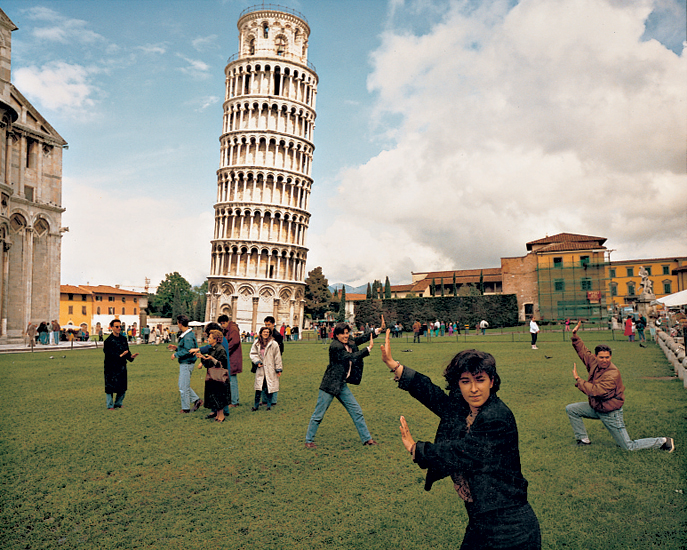
From the series Small World


In this image Martin Parr is showing how the tourists all react in the same way, he is making a humorous comment about them.

Stereotypes
places: picturesque = inspiring to make you go there
            aesthetic / nostalgia
advertising = tiny fragment of a whole
unchallenging
activities / sites of culture

Photographers used to send work back home
natural but different / exotic
painters were hired to show clients in exotic locations

people / natives add a charm element
ideological
"the grand tour"
particular view = an ideal view = not true
not showing realities of life = romantic images
happy peasants however farm life was difficult


Josie Bland
showing yourself in the location - there is a need to prove you have been
Egypt - real / run down / everyday life

Tourists Gaze
inf by magazines
Tourists visit places with preconceptions in their mind, they expect certain things, such as the world to be glamorous and exotic, they do not realise it is some peoples home and it is not exotic to them.

Thomas Gainsborough
painted aristocrats to show off the clients wealth and land


P H Emerson
pictures of east anglian life
documents similar to painters style


Frank Meadow Sutcliffe
Whitby - he photographs the local area because he did not have transport
He finds beauty in the everyday, local area he lives and works in


John Constable


Peter Kennard
reinterprets John Constable


Grief Tourism
ground zero  /  auschwitz       - why do people go?

Anselm Kiefer - interprets land - makes a point

Christian Boltanski - holocaust - photogravure

Victor Burgin - playing on war myths / aware of society

Ron O'Donnell
 - makes sculptures on statements
waterfall
consumerism

Karen Know
museums - who is it designed for?
                  why do we go?

Martin Parr
iconography / myths of british culture
shows the reality


Myths are created by the tourism industry in order to draw attention to that particular desination and attract tourists, this will bring profits into the destination.

Nature of Photographs

*Nature of Photographs by Stephen Shaw*


Colour changes the atmosphere in the photograph because the eyes are lead differently around the image because the colour catches our eye not the subject, colours can be used to manipulate because different colours have different meanings and people associate them with pre ingrained connotations. The tonality of the colours (or saturation level) can also affect the mood that the photograph emits as a dull (desaturated) image gives off a more negative connotation than a brightly over-saturated one will.

Black and White photographs do not mean that the image is more real, however the connotation of B+W are that the photograph is more artistic and that it is 'real' because of the first images that were able to be made were B+W because of technical limitations.

Context will also affect the way that photographs are read, images seen in newspapers are often dismissed yet if the same photograph appeared on a wall in a gallery there would be a different reception received. Depending on the subject the location of the photograph can be equally important as the photograph.

When people view an image they do not think of what has been omitted; these omissions are just as important, as if they had been included would the entire meaning of the photograph change? Would the atmosphere be different? Have these elements been omitted just so that the photographer can reinforce their own point instead of showing the whole picture/story?


There are two different types of framing: passive and active. A photograph with a passive framing means that the main focus is in the centre of the image and there is negative space or just small background elements against the edge of the framing. An active frame is a photograph that leads the viewers eye outside of the photograph, this could by placing the model on the edge of the photograph.

Tom Sparks
(an example of passive framing)
Darren Rowse
(an example of active framing)

Robert Adams
His works show how that man is affecting the shape and lay of the land.


Thomas Joshua Cooper
emerging / submerging / emerging
The work that he does are beautiful commentaries on the nature that surrounds us


William Eggleston


Stephen Shore


John Davies
he influenced :

The Bechers
"conceptual artists"
taught at Düsseldorf school

these people were taught at the school :

Andreas Gursky

Axel Hutte

Thomas Struth

Monday, 20 October 2014

Mass Communication and Gender


Roland Barthes
spectator theory
 rhetoric of the image
types of messages
- denoted (what is being shown visually)
- connoted (what this makes me think about)
- linguistic (what words are being used)


Stuart Hall
Three different hypothetical codes within images are:
dominant - viewer can agree with what is being shown
negotiated - the viewer understands what is being shown
oppositional - the viewer disagrees with what is being shown, to do this they must first understand it


Gramsci
Why do we use the internet?
There are many purposes for using the technology and social media that we as consumers do; there is information readily available at our hands, connecting on social media sites help us to not feel as alone however the more we use social media the more alone we feel, the entertainment available helps to fulfil our lives with daily humour and removes the feeling of 'doing nothing'


Blumler and Katz
The audience have needs which are fulfilled by the interactions they have with social media websites and tv, watching certain programmes draws friendships closer as they have mutual interests, it also serves an a form of escapism, many people get drawn into the fantasy world and forget their own lives and problems for a short period of time.


Stephen Heath
He proposed that many people enjoy the cinema because it is imitating the dreams that people have and is a form of escapism from real life. He says that people can accept the absurdity in film because the qualities are almost dream-like; sitting comfortably in a dark quiet room watching an unrealistic scene is somewhat permitted because the atmosphere reminds people of laying asleep and dreaming.


Monday, 13 October 2014

Nan Goldin


The Ballad of Sexual Dependency


preserves memories of her friends as many of them are dying
visual diary or her memories of her life and hardships

Nan Goldin referred to the Transvestite community as being a third gender, it is not meant as negative but I feel as though she means that we should celebrate their being different and expressing their true self.

This is a series of portraits that record complexity of life, it is not a decisive portrait but a collection that should be viewed together as they are all related to another